
Phase I due diligence successfully completed on schedule; Phase II of due diligence to be completed by 2 June 2025
VivoPower today announced that Energi Holdings Limited (Energi) has advised the Company of the successful completion of the first phase of due diligence in connection with the previously disclosed non-binding proportional takeover at an enterprise value of US$180 million.
Energi, headquartered in Abu Dhabi, is a global energy solutions company with US$1 billion in annual revenues and operations spanning the Middle East, Africa, South Asia, Europe, and Southeast Asia (www.energi.ae).
The first phase of due diligence, which involved commercial, financial, and operational reviews, was completed successfully on schedule.
Consequently, both parties have agreed to an accelerated second phase of due diligence, which will include a more in-depth review of regulatory, legal, and technical matters. This phase is expected to conclude by 2 June 2025, with both parties continuing to work constructively toward the goal of a binding agreement.
To read the full press release, and to keep up with all of VivoPower’s releases, visit the company's Press Releases page.
Contact
Shareholder Enquiries
Lumify Group has been named ‘Cyber Security Training Business of the Year’ in the 2025 Australian Cyber Awards, highlighting its commitment to boosting the next generation of cyber talent in Australia. Two employees of Lumify Group were also honoured as finalists in the individual categories, with Jeremy Daly recognised in the Cyber Security Rising Star (SME) award, and Louis Cremen recognised in the Cyber Security Champion of the Year (Internal) award.
These achievements reflect the company’s unmatched training offering and expertise in the local market. In 2024, Lumify Group experienced significant growth in students trained across its cyber security portfolio , with clients including Federal Government, State and local Government, Australian Defence Force, the banking and financial sectors, large enterprises, SMEs and individuals.
Lumify Group (formerly DDLS Group) offers the largest and most comprehensive range of cyber security training solutions in the country, designed for cyber professionals of all levels, from beginners to established professionals and even executives. All cyber security courses are delivered via its subsidiary companies Lumify Learn (RTO no. 45994) and Lumify Work (formerly DDLS Training).
Lumify Learn’s offering is more catered towards early-career cyber security professionals with courses ranging from Bootcamps aligned to industry certifications to Certificate III and Diplomas, which provide hands-on training and mentoring in a variety of cyber security aspects such as ethical hacking and network security.
Meanwhile, Lumify Work’s offering is catered towards established cyber security professionals looking to expand on their skillsets, providing official cyber security certification training courses from ISC2, ISACA, CompTIA, EC-Council, OffSec, PECB, Practical DevSecOps and CertNexus, as well as a wide range of vendor security courses from Microsoft, AWS, Cisco and more. Lumify Work even offers a custom workshop aimed at senior leadership, management and executive-level professionals titled “Cyber for Leadership, Executives and Boards”.
Jon Lang, CEO of Lumify Group, says “Whether we are bringing new students into the industry, upskilling businesses to meet their specific needs or assisting the government to strengthen our national security capabilities – we are deeply committed to closing the cyber skills gap. Being officially recognised by the Australian Cyber Awards is a strong reflection of this ongoing commitment.”
Lumify Work Cyber Security Lead, Jeremy Daly, adds “For more than three decades, we’ve upskilled thousands of teams and businesses, partnering with the world's top tech vendors to become Australasia's leaders in ICT training. With our combination of cyber security certification training and accredited learning, we're able to deliver on the full spectrum of IT and cyber security training from an individual’s first entry into the industry through to ongoing skills and development needed for seasoned professionals.”
Lumify Group prides itself on taking an innovative and flexible approach to learning, offering students a choice between face-to-face instructor-led training at one of its six state-of-the-art training campuses, virtual instructor-led training from anywhere, or 100% self-paced training delivered online.
All of Lumify Work’s cyber security training is delivered using a team of highly skilled and certified technical instructors who use their own professional experience to provide highly relevant and up-to-date content, providing an engaging learning experience. Lumify Work also builds custom bespoke training programs for clients with unique needs, offering tailored programs that suit their tech stacks and the roles in their team.
Lumify Group’s commitment to reducing Australia’s cyber skills gap doesn’t stop there. The company has also built a careers portal called Lumify Edge to support students seeking a career in the Australian cyber security sector. The platform pools students, businesses, and recruiters looking for IT talent together, enabling graduates to promote themselves to potential employers and apply for jobs advertised by Lumify Group’s industry partners.
Furthermore, the company has facilitated a job placement program, which provides graduates of Lumify Learn (RTO) with a job placement money-back guarantee if they do not secure full-time work upon completion of their course. The program ensures a seamless transition from education to employment, placing students with an employer to commence a 12-week IT internship within their field of study and giving them valuable real-world experience.
Visit www.lumifywork.com to learn more.
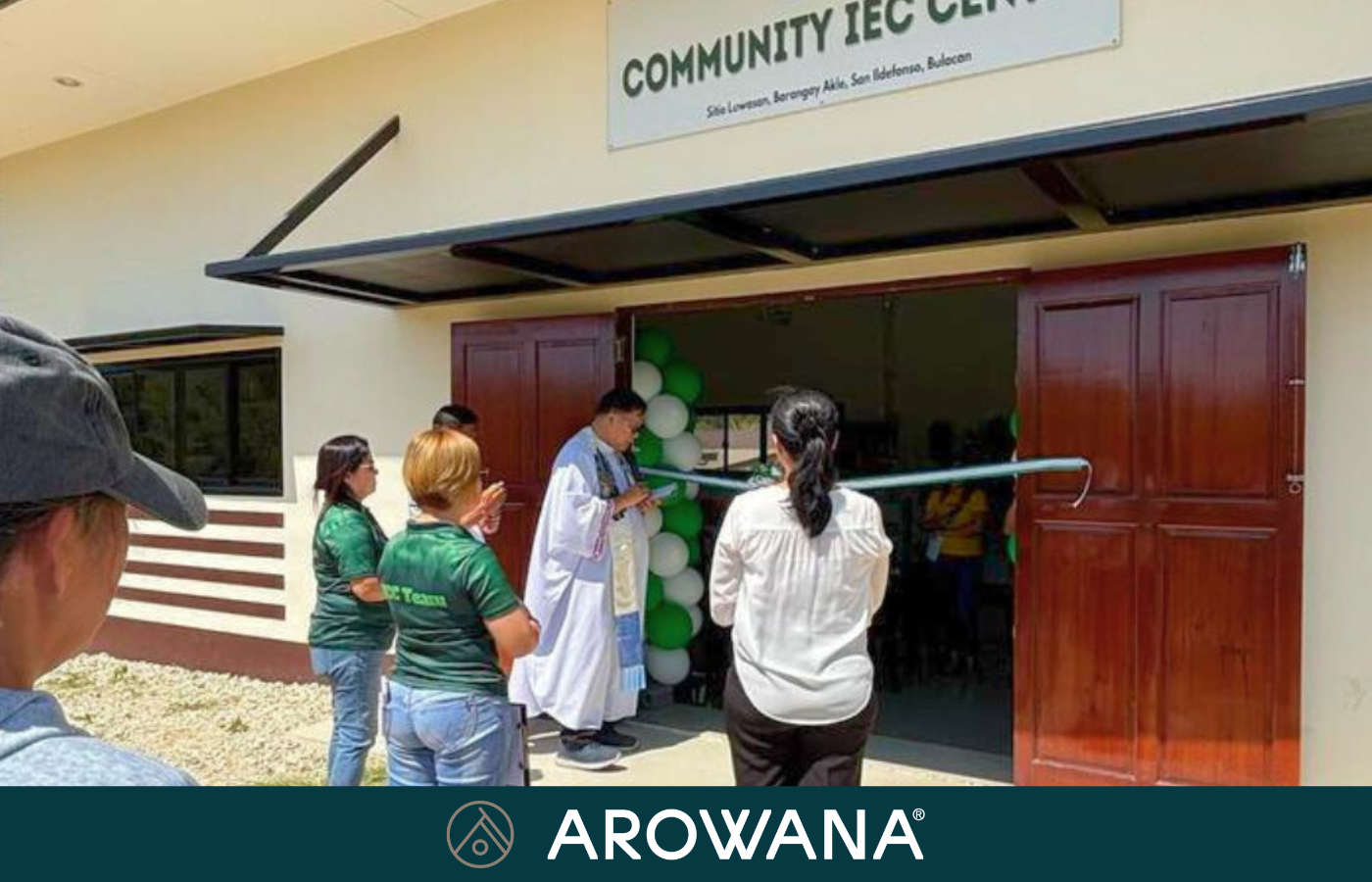
From ribbon cutting to real impact, this hub will be a game-changer in promoting the circular economy, turning plastic waste into valuable materials — bricks, blocks, and beyond.
Together with its partners, Green Antz is building a cleaner, greener future — one community at a time.
For more news and insights, stay tuned to the Arowana website.
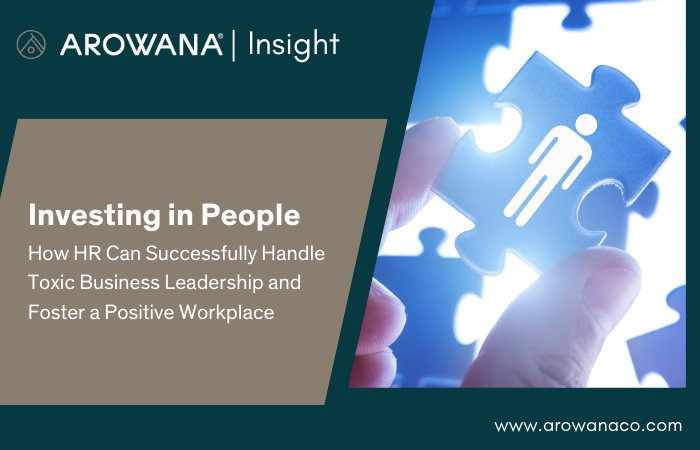
Toxic business leadership can quietly rot the core of an organisation, leading to high turnover, low morale, and plummeting performance. While many companies recognise the dangers of toxic leadership, few have a truly sustainable strategy to fix it.
This is where Human Resources (HR) plays a critical, transformative role.
The best and most sustainable way for HR to tackle issues with a toxic leader isn't to simply react when things go wrong—it's to implement a comprehensive, multi-layered approach grounded in transparency, accountability, employee well-being, and long-term cultural transformation.
Let’s explore how HR managers can build and execute a winning strategy to deal with toxic leadership—for the health of both employees and the business itself.
The first step in dealing with toxic leadership is making sure employees feel safe enough to talk about it. Too often, toxic leaders thrive because employees are too afraid to speak up. Fear of retaliation, career sabotage, or simply being ignored can silence those most affected.
HR must proactively create multiple, accessible, and confidential avenues for employees to report concerns.
Some of the most effective ways include:
However, it doesn’t stop there. Regular town halls, focus groups, and feedback sessions give employees a voice and create a culture where open dialogue becomes normalised, not feared.
When employees see that their feedback leads to real action, trust begins to build—and toxic behaviors can be surfaced early, before they cause widespread damage.
Without hard data, leadership issues often remain a matter of opinion rather than fact. To create a strong case for addressing toxic leadership, HR must rely on robust, ongoing monitoring systems. Some best practices include:
If toxic leadership is suspected, HR should also conduct deeper qualitative research, such as:
By combining data with personal testimony, HR can build an undeniable case that highlights the leadership issues at play—and move forward with evidence-based solutions.
Toxic leadership can’t be changed unless leaders are held to clear, enforceable standards. Accountability begins with transparent policies that outline:
It’s not enough to have vague guidelines buried in the employee handbook. Leadership expectations must be visible, regularly discussed, and formally incorporated into performance evaluations.
This means leaders should be assessed not only on what they achieve, but on how they achieve it. Metrics might include:
When leaders know that poor behavior will directly impact their bonuses, promotions—or even their jobs—organisations send a clear message: culture and people matter.
And importantly, if toxic behavior is repeated or severe, zero-tolerance policies must be enforced, even if that means removing high-performing but toxic leaders from their roles. Protecting the organisation’s health is always more important than protecting an individual’s position.
Not every toxic leader is malicious—sometimes, they simply lack the skills to lead effectively. That's why targeted leadership development is critical.
Instead of assuming that toxic leaders are irredeemable, HR can invest in helping them grow through:
This sends a powerful message across the organisation: Everyone, including leadership, is expected to learn, grow, and evolve.
In many cases, leaders who once exhibited toxic behaviors can, with the right support, transform into empathetic, effective managers.
Where change is possible, HR must facilitate it.
Toxic leadership almost always breeds conflict—but conflict itself isn’t always bad. Handled well, conflict can be an opportunity for healing, transparency, and cultural change.
HR must position itself as an impartial mediator between leaders and their teams. This involves:
Psychological safety—the belief that one can speak up without fear of punishment or humiliation—must be the foundation of these efforts.
When conflict resolution becomes part of the company DNA, organisations become stronger, more adaptable, and more united—even after facing leadership challenges.
Addressing toxic leadership isn’t just about fixing the bad—it’s about celebrating and reinforcing the good.
To create a workplace where toxic leadership cannot thrive, HR must actively promote positive leadership behaviors through:
Culture is built through repetition and reinforcement. When organisations consistently lift up the leaders and employees who embody their best values, those values become the new normal.
At the same time, HR must regularly review and revise company policies to ensure they reflect and reinforce the desired culture—not just on paper, but in daily practice.
There’s no "one-and-done" solution for toxic leadership. Cultural transformation is a living, breathing process that requires:
Staying vigilant is key. New challenges, external pressures, or leadership changes can always reintroduce toxicity into the system. By keeping a close watch and committing to ongoing improvement, HR ensures that toxic leadership remains the exception—not the rule.
Ultimately, sustained commitment wins the day. Not perfection, not quick fixes—just relentless, thoughtful action over time.
Toxic leadership is a serious threat—but it is not unbeatable.
HR managers are uniquely positioned to drive change, protect employees, and shape a healthier future for their organisations. By combining open communication, robust monitoring, leadership accountability, targeted development, and an unwavering commitment to positive culture, HR can not only address toxic leaders but prevent them from ever gaining a foothold again.
The reward for this hard work is immense:
When HR leads the way, everybody wins. A workplace free from toxic leadership isn’t just a dream. With the right strategy, it’s a reality well within reach.
For more news and insights, stay tuned to the Arowana website.
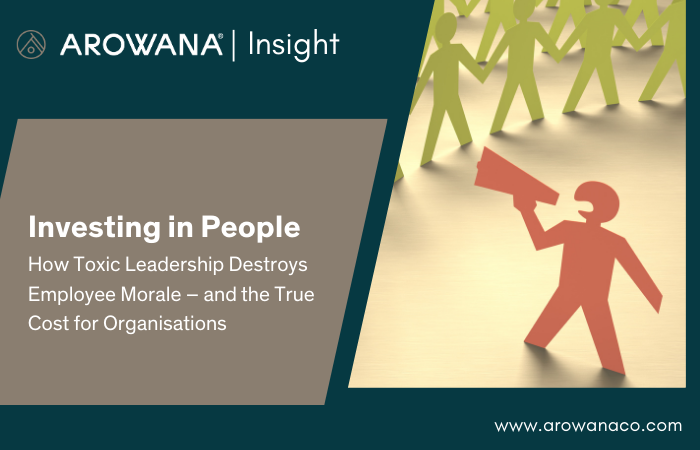
In today’s fast-paced business world, leadership isn't just about calling the shots — it's about inspiring, guiding, and building an environment where people can thrive. Yet, not all leaders rise to this ideal.
Toxic leadership — marked by manipulation, favoritism, poor communication, and lack of empathy — is a silent destroyer within organisations. It doesn't just bruise egos or create minor setbacks; it systematically erodes employee morale, wrecks team dynamics, and cripples overall company performance.
In this edition of Arowana Insights, we’ll take a deep dive into how toxic leadership affects employee morale, the warning signs organisations need to watch for, and why addressing these issues is critical for long-term success.
Toxic leadership refers to a style of management where leaders prioritise their own interests, often at the expense of their team’s well-being and the organisation’s mission. Instead of empowering employees, these leaders instill fear, insecurity, and distrust.
Common traits of toxic leaders include:
While toxic leadership can sometimes deliver short-term results, its long-term effects are devastating, leading to broken teams, burned-out employees, and massive hidden costs.
Trust is the bedrock of any healthy organisation. When leadership becomes toxic, trust is the first casualty. Employees subjected to manipulation, inconsistency, or favoritism begin to doubt their leaders — and eventually, the organisation itself.
According to a 2024 survey by Gallup, trust in leadership is directly correlated with employee engagement. Without trust, morale plummets. Workers become guarded, communication suffers, and innovation grinds to a halt.
In a toxic environment, employees often find themselves second-guessing not only their leaders but also their coworkers. Paranoia spreads, and collaboration evaporates. It's not just uncomfortable — it's organisationally dangerous.
Key takeaway: When employees can't trust leadership, morale doesn't just dip — it falls off a cliff.
Toxic leadership doesn't just stay within office walls — it takes a heavy toll on the mental health of employees. Chronic stress becomes the norm, with anxiety levels steadily rising as employees navigate unpredictable and often hostile work environments.
Research from the American Psychological Association (APA) shows that workplace stress is a leading cause of anxiety disorders, emotional exhaustion, and eventual burnout. Under toxic leadership, workers often feel trapped: powerless to change their situation but fearful of speaking up.
Burnout isn't just feeling "tired." It’s a complete emotional and psychological shutdown. Signs of burnout include:
Organisations led by toxic managers often see burnout rates skyrocket, especially among their most dedicated and high-performing employees — a tragic irony.
Key takeaway: Toxic leadership transforms the workplace from a place of growth into a source of chronic emotional distress.
Job satisfaction and employee engagement go hand-in-hand with effective, supportive leadership. In toxic environments, both steadily deteriorate. Employees begin to feel undervalued, unheard, and ultimately invisible.
When leadership consistently overlooks input, dismisses concerns, or takes credit for employee achievements, team members lose their motivation to invest emotionally in their work. As engagement drops, so does overall organisational performance.
According to a 2023 LinkedIn Workforce Report, companies with highly engaged employees outperform their competitors by 21% in profitability. Conversely, disengagement — often triggered by poor leadership — drags down productivity, customer satisfaction, and profit margins.
Key takeaway: Toxic leadership doesn't just sap satisfaction; it drains the energy and enthusiasm that fuel company success.
One of the clearest signs of toxic leadership is increased turnover. Talented employees — the very people organisations can least afford to lose — often choose to leave toxic environments rather than endure ongoing emotional harm.
A study by the Society for Human Resource Management (SHRM) found that toxic workplace cultures cost U.S. companies over $223 billion between 2015 and 2025, primarily due to employee turnover.
High turnover isn't just a numbers game. It creates significant operational challenges:
Absenteeism is another telltale symptom. Employees may start calling in sick more frequently, using mental health days to escape the toxic atmosphere.
Key takeaway: If your best people are leaving or frequently absent, toxic leadership could be to blame — and the financial cost is staggering.
Leadership should act as a catalyst for high performance, but in toxic environments, it becomes a bottleneck. Demotivated, stressed, and disengaged employees are far less likely to perform at their best.
Instead of bringing new ideas, solving problems creatively, or going the extra mile, employees under toxic leadership often do only what’s required — no more, no less. This phenomenon, known as "quiet quitting," is becoming alarmingly common in toxic workplaces.
Productivity suffers in multiple ways:
When morale hits rock bottom, organisations often find themselves struggling to compete — not because they lack talent, but because they failed to nurture it.
Key takeaway: Toxic leadership doesn't just dim individual performance; it darkens the entire organisation's future.
Teams thrive on trust, mutual respect, and open communication. Toxic leaders, however, often sow division instead. Whether through overt favoritism, scapegoating, or pitting employees against each other, these leaders create fractured, distrustful teams.
In such environments, communication becomes guarded or entirely shuts down. Employees fear retaliation for honest feedback or dissenting opinions. Meetings become performances rather than platforms for real collaboration.
Ultimately, a breakdown in communication leads to:
According to Forbes, highly cohesive teams are 50% more productive and 30% more innovative than fragmented ones. Toxic leadership not only undermines cohesion — it actively destroys it.
Key takeaway: Toxic leaders don’t just damage individual relationships — they dismantle the entire social fabric of the workplace.
The impacts of toxic leadership are not confined to working hours. Stress, anxiety, and dissatisfaction often spill over into employees' personal lives, affecting their health, relationships, and overall well-being.
Employees under toxic leadership may experience:
This spillover effect creates a vicious cycle. As personal lives become strained, employees’ ability to focus and perform at work deteriorates further, perpetuating the negative impacts.
Beyond the individual level, toxic leadership also damages an organisation’s brand reputation. Glassdoor reviews, employee testimonials, and word-of-mouth all suffer when people feel mistreated.
Key takeaway: Toxic leadership doesn't clock out at 5 PM — it continues to hurt employees long after they leave the office.
The longer an organisation tolerates toxic leadership, the deeper the damage becomes. Companies that fail to act risk not only losing their best employees but also facing long-term reputational and financial consequences.
Key steps organisations can take include:
Ultimately, companies that foster healthy, supportive leadership styles reap massive benefits: higher engagement, stronger performance, lower turnover, and a reputation as an employer of choice.
At its core, leadership is not just about meeting KPIs or maximising quarterly profits. It’s about creating environments where people feel safe, valued, and inspired to do their best work.
Toxic leadership is a hidden epidemic in many organisations, silently eroding morale, trust, and performance. Its impacts stretch far beyond the workplace, affecting the mental health and well-being of employees — and eventually the bottom line.
Companies that recognise, confront, and correct toxic leadership will not only save their cultures — they’ll position themselves for sustainable success in a world where talent and innovation are the ultimate competitive advantages.
For more news and insights, stay tuned to the Arowana website.
The Safari Collection is a world-renowned luxury safari company and owner of the Giraffe Manor
This is another leading safari company in Africa that has placed an order with Tembo
The first order was from Asilia Africa announced in February 2025
Tembo's solutions selected to drive sustainable safari experiences across Kenya
VivoPower is pleased to announce that its wholly-owned subsidiary, Tembo e-LV, has secured an inaugural order for its EV conversion kits from The Safari Collection, owner of luxury properties in Kenya, including the Giraffe Manor, Sasaab, Sala's Camp and Solio Lodge.
Established in 2009 by conservationists and safari entrepreneurs, Tanya and Mikey Carr-Hartley, The Safari Collection is a privately owned portfolio of distinctive luxury camps and lodges set in some of the most breathtaking locations across Kenya. Born from a deep passion for sharing the magic of Africa with the world, the company has grown into a leading name in bespoke safari experiences. With a strong focus on sustainable environmental practices and community empowerment, The Safari Collection plays a vital role in creating meaningful economic opportunities for the people of Kenya, all while preserving the extraordinary natural heritage of the region.
Tanya Carr-Hartley, Co-Founder of The Safari Collection, said: “At the Safari Collection, our commitment to preserving Kenya’s wild beauty goes hand in hand with innovation. Partnering with Tembo to electrify our vehicle fleet is a natural extension of our mission – to offer world-class safari experiences while treading lightly on the land we so deeply cherish. This is not just about mobility; it’s about sustainability, legacy, and protecting the places we love for future generations.”
Mikey Carr-Hartley, Co-Founder of The Safari Collection, said: “Our lodges are located in some of the most pristine, remote landscapes in Africa. Switching to electric safari vehicles helps ensure these extraordinary ecosystems remain intact – not only for our guests today, but for our children tomorrow. After having evaluated a number of alternative options, we decided to proceed with Tembo as their solutions were superior and more cost effective than other offerings in the market.”
Matthew Nestor, VivoPower’s Global Head of Partnerships and Sales, said: “We’re thrilled to partner with The Safari Collection, an organisation whose values of conservation, innovation, and local stewardship closely mirror our own. By electrifying their safari fleet, they’re not just leading by example in eco-tourism, but also proving that luxury and sustainability can go hand in hand, even in the most rugged environments.”
To read the full press release, and to keep up with all of VivoPower’s releases, visit the company's Press Releases page.
About The Safari Collection
Founded by Tanya and Mikey Carr-Hartley in 2009, The Safari Collection is a family-run portfolio offering immersive experiences at six unique properties in the finest locations in Kenya. The Carr-Hartleys are a family passionate about adventure, the spectacular un-spoilt wilderness areas of their home country and protecting it for future generations. It is from this pioneering spirit and love for Kenya’s wildest corners that The Safari Collection was born. The energy and passion of their dynamic team flows through everything that they do. The Safari Collection's authentic, first-hand knowledge spans the entire region to create unique, cutting-edge experiences.
Contact
Shareholder Enquiries
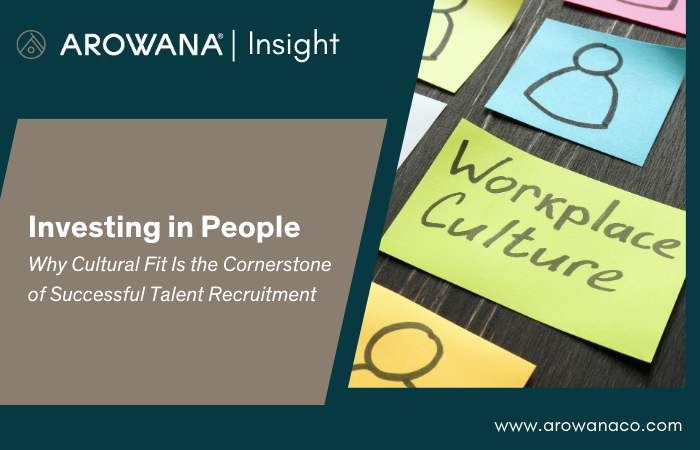
Recruiting the right talent goes beyond finding impressive résumés and technical skill sets in your candidate pipeline. Amid ongoing pressure for businesses to scale up, culture fit has become one of the more critical factors in hiring success.
Culture fit isn’t just a “soft” consideration; it’s a decisive element that influences engagement, performance, collaboration, retention, and brand reputation.
When companies prioritise culture fit during recruitment, they build teams that are stronger, more cohesive, and ultimately better positioned for long-term success.
Here’s why culture fit should sit at the heart of any talent acquisition strategy – and how it can transform the future of any organisation.
When employees feel aligned with an organisation’s culture, they are naturally more engaged and satisfied in their roles. They aren’t just completing tasks – they are participating in a shared mission that resonates with their personal values and work styles.
Employees who experience cultural alignment tend to demonstrate:
Research shows engaged employees are more productive, innovative, and loyal. They’re the people who bring fresh ideas to the table, who persevere during challenges, and who go the extra mile – not because they have to, but because they want to.
In short: When employees find meaning in their work, they deliver meaningfully better results.
An aligned culture acts as the connective tissue that binds a team together. When team members share core values and compatible work styles, they communicate more easily, trust each other more readily, and collaborate more effectively.
Teams that are culturally aligned are more likely to:
Organisations that focus on culture fit build teams that work together harmoniously, regardless of individual differences. This leads to higher collective performance, stronger creativity, and faster execution on projects.
Without cultural alignment, even the most talented individuals can find themselves working at cross purposes, leading to friction, inefficiency, and lost opportunities.
Teamwork thrives where shared values live.
Hiring mistakes are costly – not just financially, but in lost time, energy, and momentum. One of the most frequent and preventable causes of early employee departure is poor culture fit. In fact, 73% of professionals have reported leaving a job because they didn’t feel aligned with the organisation’s culture.
When companies focus on culture fit, they foster environments where employees feel truly at home. This sense of belonging directly contributes to higher retention rates, saving organisations the significant costs associated with frequent turnover, such as:
A stable, cohesive workforce also preserves institutional knowledge and builds stronger organisational memory, creating a powerful foundation for growth.
Retention begins with connection – and connection begins with culture.
Employees are the most powerful brand ambassadors an organisation can have. Their behaviour – both inside and outside the company – shapes public perceptions and influences customer trust.
When employees embody the organisation’s values and culture, they deliver a consistent, authentic experience to:
A strong, well-aligned culture enhances the organisation’s reputation, making it more attractive not just to prospective employees but also to investors, collaborators, and clients.
On the other hand, cultural mismatches can lead to inconsistent service, misaligned messaging, and reputational risk.
In today’s transparent world, internal culture is external brand.
Change is inevitable – and the ability to adapt is essential. Employees who fit well with the culture are better positioned to embrace change, integrate into new systems, and support evolving strategies.
Cultural alignment helps new hires:
While technical skills can be taught, cultural adaptability is far harder to instill after someone joins the team. That’s why forward-thinking organisations emphasise culture fit from the very start.
A workforce that shares a core cultural foundation can pivot faster, innovate smarter, and overcome obstacles more effectively than a fragmented one.
Skills evolve. Culture sustains.
Employees who are culturally aligned don’t just show up – they show up at their best. Research indicates that employees who fit well with an organisation’s culture are 20% more likely to achieve high performance levels.
This happens because:
When individuals feel connected to the larger mission and values of an organisation, their intrinsic motivation skyrockets. They don't simply work for rewards; they work for meaning.
This enhanced performance at the individual level naturally compounds at the organisational level. Departments become more efficient, customer experiences improve, and overall productivity increases.
Great performance isn’t demanded – it’s inspired by shared purpose.
Turnover due to poor culture fit can cost an organisation between 50% and 60% of the departing employee’s annual salary, with some estimates suggesting it can climb even higher when factoring in hidden costs like:
Prioritising culture fit from the beginning is a proactive investment that saves considerable time, energy, and financial resources.
It ensures that companies are building teams with lasting impact rather than constantly patching holes from misaligned hires. The more deliberate the focus on fit, the stronger and more resilient the workforce becomes over time.
Hire right the first time – and build a team that stands the test of time.
Culture fit should be an intentional, structured part of the recruitment process, not a vague gut feeling or afterthought.
Here’s how organisations can effectively evaluate and prioritise culture fit when hiring:
Before assessing candidates for fit, companies must have a well-articulated understanding of their own culture, including:
Communicating these elements early in the recruitment process – through job postings, interviews, and branding materials – helps attract candidates who resonate with the culture.
Behavioral interviewing techniques allow recruiters to explore how candidates have acted in real-world scenarios, providing insight into their values, decision-making processes, and interpersonal styles.
Questions might include:
The goal is to assess not just what candidates say they value – but how they demonstrate those values in action.
Having candidates meet with a cross-section of team members offers multiple perspectives on cultural compatibility. It also gives the candidate a broader sense of the organisation’s environment, increasing the likelihood of a mutually informed decision.
Asking candidates to work through hypothetical or real business challenges can reveal a lot about:
Simulations offer a practical way to observe whether a candidate's working style aligns with organisational culture.
Some organisations go further by using values alignment surveys or structured assessments to gauge how closely candidates’ personal priorities align with the company's core beliefs.
This structured evaluation can provide additional confidence in hiring decisions, especially for roles that demand high levels of leadership or cultural stewardship.
Culture fit isn’t about creating a monolithic workforce where everyone thinks alike. It’s about ensuring that diverse individuals can flourish together within a shared framework of values and purpose.
Prioritising culture fit during recruitment leads to a workplace where:
Culture is the one advantage that competitors cannot easily replicate. This is especially true in today’s workplace environment, where rapid change and fierce competition is constant. Organisations that protect and nurture their culture – starting with every new hire – will be the ones that not only survive but thrive for decades to come.
Because when people and culture align, extraordinary things happen.
For more news and insights, stay tuned to the Arowana website.
Arowana’s B Corp holding company will provide a succession and ownership transition pathway for B Corp founders seeking to exit but retain the ethos of their businesses
Investment focus will initially be on the ASEAN region but in time look to expand to other developing economies across the MENA and Latin American regions with large and growing populations
Arowana, the global B Corporation investment group, announced today that it has launched a holding company headquartered in Singapore to specifically invest in companies committed to the B Corp triple bottom line of People, Planet, and Profit across the ASEAN (Association of Southeast Asian Nations) region.
The primary purpose of this holding company, AIC Group Holdings, is to provide companies that are B Corp or want to become B Corp with an ownership succession pathway, which will respect and perpetuate the B Corp ethos and culture instilled by their founders. AIC Group Holdings is privately held.
In tandem with the launch of the holding company, Arowana has appointed Andrew Kassoy, co-founder of B Lab Global, the non-profit behind the B Corp movement, to the Advisory Board of AIC Group Holdings. In addition, Thomas Ng, a leading B Corp entrepreneur and founder of Genashtim, a fast-growing global social enterprise, has agreed to join the Advisory Board.
Arowana founder and chairman, Kevin Chin, commented: “We have been working on optimising a structure for two years and believe a holding company that has no restrictions in terms of investment entry and exit horizons is the best model that matches the succession and growth objectives of B Corp founders and their businesses. As a B Corp ourselves, we appreciate the dilemma that founders face in this regard. We consider Singapore to be the ideal headquarters for this holding company as we see many enterprises across the fast-growing ASEAN region that would be a good fit. This is consistent with Arowana’s broader strategy of pivoting our focus to developing markets across ASEAN and, in due time, Africa and Latin America with large and growing populations and economies.”
He further added: “I am honoured that two luminaries of the B Corp movement, Andrew Kassoy and Thomas Ng, have agreed to join the Arowana holding company advisory board members. Not only are Andrew and Thomas great stewards, but also world-class entrepreneurs who have led the scale-up of high-growth global enterprises. We expect to announce further additions to the advisory board and the holding company team in due course. Meanwhile, our team is already in exclusive due diligence processes on four proprietary investment opportunities in the ASEAN region that have come about because of Arowana’s veritable commitment to the B Corp ethos.”
Andrew Kassoy, co-founder of B Lab Global, commented: “Since the earliest days of the B Corp movement, we have seen first-hand the issues of succession and ownership transition faced by B Corp founders, especially when deliberating on acquisition proposals from non-B Corp entities. I am excited to join the Arowana B Corp holding company advisory board as I share the vision that Kevin Chin has in creating a permanent capital holding company structure with a genuine B Corp ethos that provides a compelling option for B Corp founders exploring succession and exit.”
Thomas Ng, B Corp steward and founder, said: “Having known Kevin Chin for some time and seeing first-hand his steadfast commitment to the B Corp values and mission, I am delighted to be joining the Arowana B Corp holding company advisory board. Across Genashtim’s operations in the ASEAN, African and Latin America regions, we see many businesses that the Arowana B Corp holding company would represent an attractive alternative to consider for succession and ownership transition.”
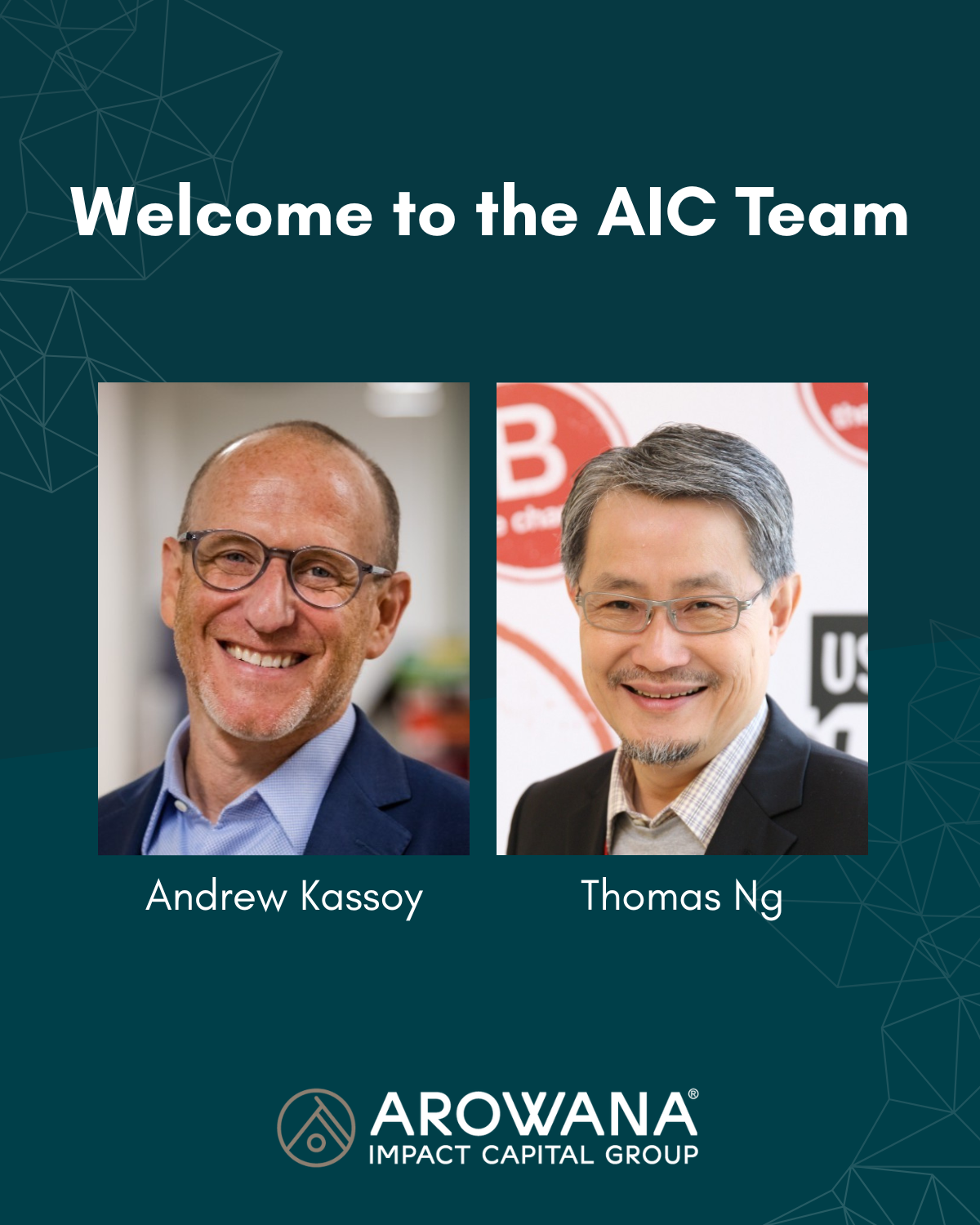
For more news and insights, stay tuned to the Arowana website.
Media Contact
Arowana Digital
Agreement with Green Watt represents Tembo’s first deal in fast growing Saudi Arabian market
Green Watt has signed agreement with Tembo to sell and distribute 1,600 Tembo EUV units in the Kingdom of Saudi Arabia (KSA) up to 2030
Green Watt’s customer base includes Aramco, the world’s largest oil company, Halliburton, Honeywell, Baker Hughes and the Saudi Electric Company
VivoPower announced today that its subsidiary, Tembo e-LV (Tembo), has signed a Definitive Distribution Agreement worth up to an estimated US$85 million with leading Saudi Arabian energy and environmental solutions provider Green Watt to sell and distribute 1,600 Tembo electric utility vehicle (EUV) units across the Kingdom of Saudi Arabia over the next five years.
Green Watt is a KSA-based company established in 2016 and specializes in the areas of renewable energy, energy conservation, and environmental sustainability. With strong emphasis on environmental protection, quality and transparency, Green Watt assists its clients to achieve their financial and environmental objectives. By implementing energy conservation measures (ECMs), Green Watt ensures reduced power consumption, reduced cost and carbon footprint. In addition to that, Green Watt provides solutions ranging from stand-alone PV systems to complex hybrid applications. Customers of Green Watt include Aramco, Halliburton, the Saudi Electric Company, Honeywell, Baker Hughes, JAL International, and Al Mansoori, among others.
The strategic distribution agreement between VivoPower and Green Watt reflects both companies' shared commitment to advancing sustainable energy solutions in the Kingdom of Saudi Arabia.
Saudi Arabia presents an opportunity for corporate partnerships in sustainable energy solutions, driven by strong government support and ambitious carbon reduction targets aligned with global sustainability goals. The widespread use of ruggedized utility vehicles, such as the Land Cruiser 70 series, by law enforcement and government agencies, as well as the mining, oil and gas and other industrial sectors means there is a significant addressable market for electrification.
With numerous agencies and corporates operating under vehicle lease structures, converting used Land Cruisers to electric and re-leasing them offers a practical, cost-effective pathway to electrification. This model not only lowers operational costs but also supports the KSA’s transition to a greener economy.
Nazir Muhammad, CEO of Green Watt, said: “At Green Watt, we believe in electrifying the future of mobility, not just in words but in action. Our partnership with Tembo marks a decisive step towards cleaner, smarter transportation solutions across emerging markets. Together, we’re not only reducing emissions but also empowering communities with sustainable technologies that work for people and the planet.”
Matthew Nestor, Director, Head of Global Partnerships at VivoPower, said: “This partnership with Green Watt is a strategic milestone in our mission to deliver turnkey sustainable energy solutions to the Kingdom of Saudi Arabia. Nazir and the Green Watt team share our commitment to decarbonizing transport in a commercially viable and socially impactful way. By joining forces, we’re accelerating the deployment of Tembo’s electrification technology in a country committed to decarbonisation, where it can make a transformative difference.”
To read the full press release and to keep up with all of VivoPower’s releases, visit the company's Press Releases page.
About Green Watt
Established in 2016, Green Watt is led by a team with over 25 years of experience in the energy sector. The company specializes in the areas of renewable energy, energy conservation, and environmental sustainability.
With a strong emphasis on environmental protection, quality, and transparency, Green Watt assists clients in achieving their financial and environmental objectives. By implementing energy conservation measures (ECMs) the company ensures reduced power consumption, reduced cost, and carbon footprint. In addition to that, Green Watt provides solutions ranging from stand-alone PV systems to complex hybrid applications.
Contact
Shareholder Enquiries

The Plain English Foundation has welcomed Juliana Ribeiro as the team's new Marketing Manager. A 15-year veteran of the marketing industry, Ribeiro specialises in the business-to-business industry, but has worked in a range of industries, including luxury goods, software as a service, and business to consumers.
Ribeiro lives by Thomas Jefferson’s wisdom, "The most valuable of all talents is that of never using two words when one will do."
Expect clear, concise, and effective communication from Juliana as she helps us spread the word about plain language.
For more news and insights, stay tuned to the Arowana website.


